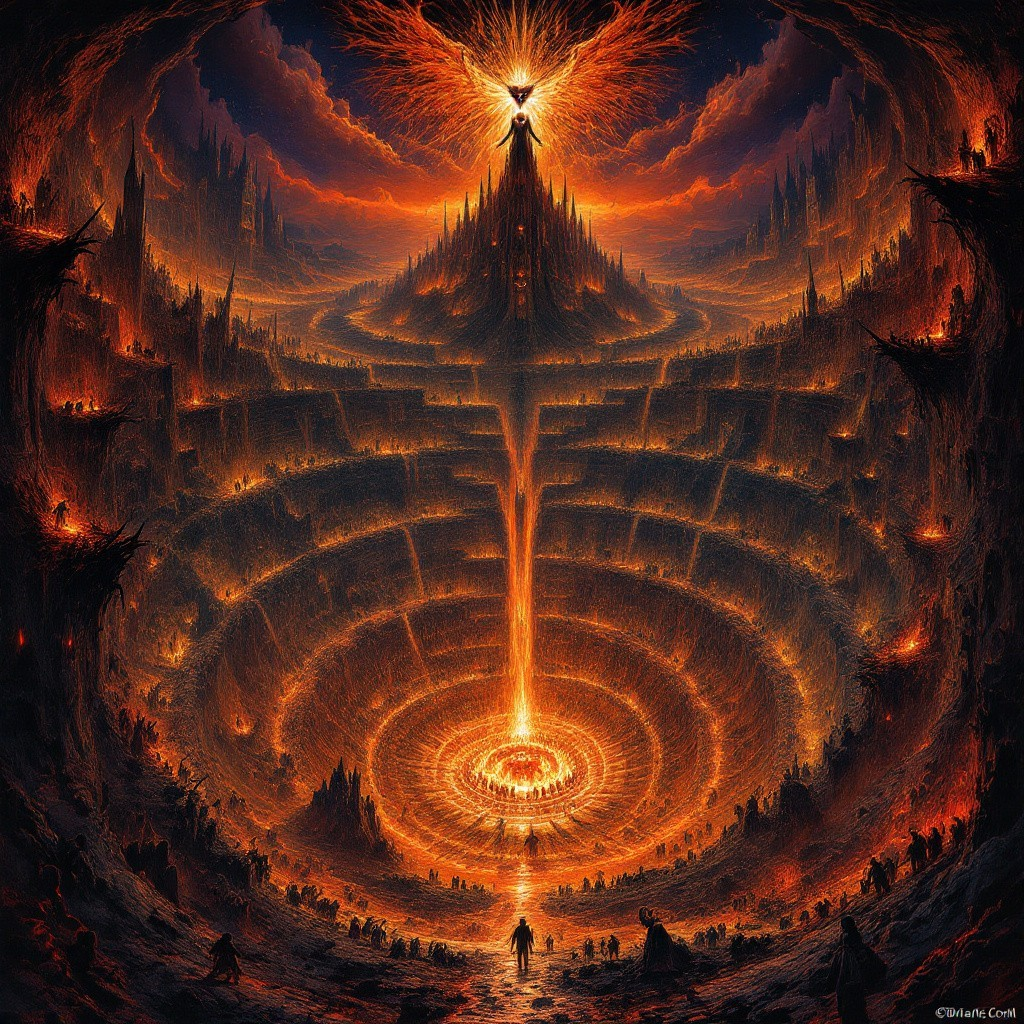
Classification: Dante's Inferno
A Literary Depiction of Hell — Early 14th Century
✦ ✠ VIII ✠ ✦
The descent changes here.
Dante's Inferno imagines Hell not as a single
landscape, but as a vast ordered abyss descending
through nine circles, where punishments correspond
to the moral character of the sins committed in life.
Descend Through the Circles
↓
Fig. 1.8
A symbolic artistic interpretation of Dante's Inferno
and the descent through the Nine Circles of Hell.
Overview
Dante's Architecture of Damnation
Among the most influential visions of hell in Western
literature is the Nine Circles of Hell described in
Dante Alighieri's Inferno, the first part of
his epic poem The Divine Comedy, completed in
the early fourteenth century.
Although not an official doctrine of the Roman Catholic
Church, Dante's imaginative portrayal of the afterlife
has profoundly shaped popular conceptions of hell for
more than seven centuries.
In Dante's vision, hell is structured as a vast,
funnel-shaped abyss descending deep beneath the earth,
divided into nine concentric circles that punish
sinners according to the nature and severity of their
offenses.
Each successive circle represents increasingly
grievous sins, while the punishments inflicted upon
the damned are carefully designed according to the
principle of contrapasso—the idea that each
soul experiences a punishment reflecting the moral
character of its earthly wrongdoing.
Rather than presenting random suffering, Dante's hell
is portrayed as a perfectly ordered realm where divine
justice assigns every sinner to a place corresponding
to his or her choices in life.
Catholic Teaching
Dante drew heavily upon medieval Catholic theology,
Scripture, philosophy, and the religious imagination
of his age.
The detailed geography of nine descending circles,
however, should not be treated as an official map
or doctrine of the Roman Catholic Church.
Dante's Inferno
The Nine Circles belong to Dante's literary vision:
an intricately organized poetic Hell populated by
historical figures, mythological beings, political
enemies, biblical characters, monsters, and the
damned.
The Law of Dante's Hell
Contrapasso
Punishment reflects sin.
The damned do not merely suffer; their punishments
symbolically echo, expose, reverse, or eternally
reenact the moral character of the choices that
defined them in life.
The Nine Circles
The deeper the descent, the more grievous the sin.
The Center of Hell
Satan imprisoned within the eternal ice of Cocytus
Descending the Inferno
From Limbo to the Frozen Center
The journey begins in the First Circle, known as
Limbo, where virtuous non-Christians and unbaptized
infants dwell without physical torment but remain
forever deprived of the vision of God.
As Dante descends through the remaining circles, he
encounters those guilty of lust, gluttony, greed,
wrath, heresy, violence, fraud, and treachery.
Each realm possesses its own distinctive landscape
and symbolic punishments.
The lustful are forever swept through violent storms,
mirroring their inability to control earthly passions,
while the gluttonous lie in foul, freezing rain.
The fraudulent endure elaborate deceptions within the
ten ditches of Malebolge, and traitors are imprisoned
in the frozen Lake Cocytus at the very center of hell.
There, Satan himself remains trapped in eternal ice,
endlessly chewing history's greatest betrayers—Judas
Iscariot, Brutus, and Cassius.
Circle I
Limbo
Dante places virtuous non-Christians and
unbaptized souls here.
Their condition lacks the physical torment found
deeper in the Inferno, but they remain eternally
separated from the vision of God.
Circle II
Lust
The lustful are swept relentlessly through a
violent storm.
The uncontrolled winds mirror passions that,
within Dante's moral symbolism, overpowered
reason during earthly life.
Circle III
Gluttony
The gluttonous lie beneath foul, freezing rain
in a landscape of degradation and excess,
transforming appetite into an atmosphere of
endless misery.
Circle IV
Greed
Dante's fourth circle contains souls associated
with avarice and prodigality, continuing the
Inferno's progression from disordered appetite
toward increasingly serious moral offenses.
Circle V
Wrath
The wrathful and the sullen are associated with
the marsh of the Styx as Dante approaches the
fortified city of Dis and the darker regions
below.
Circle VI
Heresy
Beyond the walls of Dis lies Dante's sixth
circle, marking a deeper stage in the poem's
moral architecture and the descent toward
violence, fraud, and treachery.
Circle VII
Violence
The seventh circle is associated with violence
and is divided into separate regions within
Dante's elaborate ordering of sins and their
corresponding punishments.
Circle VIII
Fraud — Malebolge
Fraud occupies the ten ditches of Malebolge,
where Dante imagines elaborate punishments and
deceptions within one of the Inferno's most
intricate landscapes.
Circle IX
Treachery — Cocytus
At the deepest point of the Inferno, traitors
are imprisoned within the frozen Lake Cocytus.
Fire gives way to ice as Dante reaches the
terrible stillness at the center of Hell.
At the Bottom of the World
The Frozen Lake Cocytus
Dante's descent ends not in an ocean of flame,
but in ice.
At the center of the frozen lake stands Satan,
himself imprisoned within the Inferno he appears
to rule, eternally chewing Judas Iscariot,
Brutus, and Cassius.
In Dante's Inferno, the path downward is also a
map of moral gravity: the deeper the travelers
descend, the more deliberately destructive the
sins become.
An Enduring Vision of Hell
Seven Centuries in the Human Imagination
Although Inferno is a literary masterpiece
rather than sacred scripture, its influence on
Christian imagination has been extraordinary.
Dante drew upon biblical imagery, classical mythology,
medieval theology, philosophy, and contemporary
politics to create one of history's most detailed
depictions of the afterlife.
His vision established enduring images of descending
circles, individualized punishments, infernal
landscapes, monstrous guardians, and the moral
ordering of sin.
Countless artists, writers, composers, filmmakers,
and game designers have drawn inspiration from
Dante's work, making the Nine Circles of Hell one
of the most recognizable representations of eternal
punishment in world literature.
While distinct from official Catholic teaching,
Dante's imaginative geography of hell remains one
of humanity's most enduring symbolic explorations
of justice, morality, and the consequences of sin.
Primary Sources
Texts Behind the Inferno
Dante Alighieri,
Inferno
(Cantos I–XXXIV)
The Divine Comedy
Virgil,
Aeneid
— literary influence
Aristotle,
Nicomachean Ethics
— classification of sins
Thomas Aquinas,
Summa Theologiae
— theological influence
Dante's Hell emerges from a convergence of poetry,
classical literature, medieval philosophy, Christian
theology, political history, and the imagination of
one of the most influential writers in Western
literature.
Key Beliefs
The Moral Architecture of Dante's Inferno
Hell consists of nine descending concentric circles.
Punishments correspond directly to the sinner's
earthly sins through the principle of
contrapasso.
More serious sins are punished in deeper circles.
Satan resides at the center of hell, imprisoned
in ice.
The structure reflects divine justice and moral
order within Dante's literary vision.
The Inferno is a literary vision,
not official Catholic doctrine.
The Principle Beneath the Punishments
Sin Becomes Landscape
Dante does not populate his Inferno with arbitrary
punishments.
The storms, rain, tombs, rivers, ditches, monsters,
and frozen depths become part of the poem's moral
symbolism, giving physical form to the nature of
the sins being represented.
Historical Development
From Medieval Poem to Cultural Mythology
Dante Alighieri composed
The Divine Comedy
between approximately 1308 and 1321 during his exile
from Florence.
Drawing upon Scripture, Catholic theology,
Aristotelian philosophy, Roman literature, and
medieval cosmology, he created an intricate vision
of the afterlife that organized sins according to
reason and morality.
Although the Catholic Church has never regarded the
Nine Circles as literal doctrine, Dante's poetic
vision became one of the most influential
representations of hell in Western civilization.
Renaissance artists, theologians, and later writers
frequently borrowed its imagery, cementing its place
in literature, art, and popular culture.
Classical Foundations
Dante's imagined underworld draws in part upon
the classical literary tradition represented in
works such as Virgil's Aeneid.
Medieval Intellectual World
Christian theology, Aristotelian philosophy,
medieval cosmology, Scripture, and ideas about
morality helped shape the intellectual setting
in which Dante constructed his Inferno.
c. 1308–1321
Dante composed The Divine Comedy during
the later years of his life following his exile
from Florence.
The Inferno
The poem's first part created an extraordinarily
detailed descent through Hell, combining moral
philosophy, religious imagery, politics,
mythology, history, and poetry.
Enduring Legacy
Later artists and writers repeatedly returned to
Dante's imagery, helping transform the Nine
Circles into one of the world's most recognizable
literary visions of Hell.
Influence on Western Culture
When Literature Redefined the Image of Hell
Few literary works have shaped humanity's image of
hell as profoundly as Dante's Inferno.
Its detailed geography, memorable punishments, and
vivid symbolism have inspired countless paintings,
sculptures, operas, novels, films, comics, and video
games.
Expressions such as the "Nine Circles of Hell" have
entered everyday language as metaphors for extreme
suffering or moral descent.
Dante's influence extends beyond religion into
philosophy, psychology, and cultural studies, where
his work continues to be examined as one of
history's greatest explorations of justice, free
will, sin, and redemption.
✒
Literature
◈
Visual Art
♫
Music & Opera
◉
Film
✦
Comics
◆
Video Games
⚖
Philosophy
IX
Popular Culture
More than seven centuries after its creation,
Dante's descent still supplies much of the visual
vocabulary through which popular culture imagines
Hell.
The final landscape of Dante's Inferno overturns
the familiar expectation of a Hell consumed by
flame.
The deepest circle is frozen.
Traitors are imprisoned within the ice of Cocytus,
and at the center stands Satan—immense, trapped,
and unable to escape the very realm with which he
has become synonymous.
The journey has reached the bottom of Dante's
universe.
There is nowhere left to descend within the
Nine Circles.
Beyond Dante's Inferno
Beyond the Ninth Circle
The frozen center of Dante's Hell lies behind you.
The circles have ended.
The ordered abyss has reached its deepest point.
But The Encyclopedia of Hell does not end with
Dante.
Beyond the Eighth Chamber waits another monumental
literary vision of the infernal realm—a capital of
demons raised from the darkness of John Milton's
imagination.
AI-Assisted Content Notice:
Portions of this entry were drafted with assistance
from ChatGPT (OpenAI, 2026) and subsequently edited
for accuracy, clarity, and theological consistency.