Overview
Purification Promised · Salvation Withheld
Although often confused with hell in popular culture,
Purgatory occupies a fundamentally different place in
Roman Catholic theology.
Rather than serving as a realm of eternal punishment
for the damned, Purgatory is understood as a temporary
state of purification for those who die in God's
friendship but who still require cleansing from the
lingering effects of sin before entering heaven.
According to Catholic teaching, nothing imperfect can
enter the full presence of God. Therefore, souls
destined for eternal salvation may undergo a final
purification so they can behold God in the Beatific
Vision.
The suffering associated with Purgatory is not viewed
as retribution or condemnation but as a merciful
process through which the soul is made completely holy.
For this reason, the Church distinguishes Purgatory
from hell in both purpose and duration: hell is
eternal separation from God, whereas Purgatory ends
in everlasting communion with Him.
In this chamber of the Encyclopedia of Hell, however,
that distinction becomes the foundation of the horror:
the purification process is repeated but never
achieved.
Catholic Purgatory
In Roman Catholic teaching, Purgatory is temporary.
The soul is purified, its journey has an end, and
those who undergo this purification are ultimately
destined for communion with God.
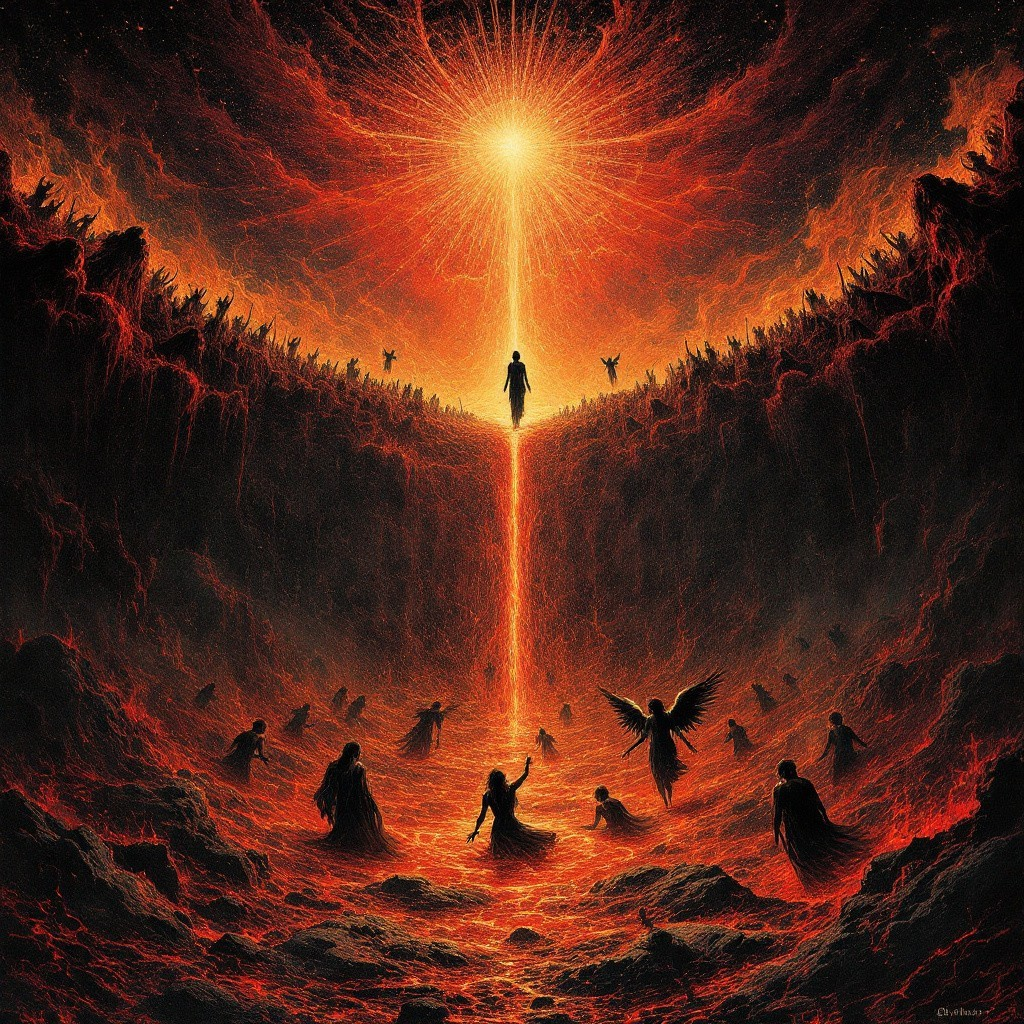
Chamber VII
Here, the structure of purification has been
corrupted into punishment. The soul suffers,
expects cleansing, sees the suggestion of ascent,
and continues forward—but the promised completion
never comes.
The Corruption of Purgatory
The terror of Chamber VII is not simply the flame.
It is the transformation of hope itself into an
instrument of torment.
The concept finds its biblical foundation in passages
interpreted as implying postmortem purification,
including 1 Corinthians 3:13–15, where a person's
works are tested "as through fire," and
2 Maccabees 12:38–46, which describes prayers offered
for the dead.
Catholic tradition also points to Jesus' teaching that
some sins may be forgiven "in the age to come" and to
the longstanding practice of praying for the faithful
departed.
In the distorted reality of this chamber, however,
such completion is unachievable.
Over the centuries, theologians such as St. Augustine,
St. Gregory the Great, and St. Thomas Aquinas further
developed the doctrine, explaining that the soul's
purification prepares it for the perfect holiness
required to enter heaven.
The imagery of purifying fire has become the defining
symbol of Purgatory, though the Catholic Church has
never officially declared that this fire is physical
in nature.
Many theologians understand it metaphorically,
representing the soul's intense encounter with God's
holiness and love, which burns away every remaining
attachment to sin.
In Chamber VII, judgment is final and redemption never
arrives.
Others have interpreted the fire more literally while
maintaining that its purpose in Catholic Purgatory is
entirely restorative rather than punitive.
Regardless of how the imagery is understood, Catholic
Purgatory is characterized by hope rather than despair.
Every soul in Purgatory is assured of eventual entrance
into heaven, making it a state of anticipation rather
than hopelessness.
Here, that expectation is twisted into endless false
hope.
The doctrine itself reflects the Catholic conviction
that God's justice is inseparable from His mercy,
offering final purification to those who die in grace
but are not yet fully prepared for eternal communion
with Him.
The souls imagined within this chamber, however, never
discover that the ascent has no summit.
The Punishment of Chamber VII
The False Promise of Purification
Every flame appears to be the final flame.
Every trial seems to bring the soul closer to
release.
Every distant light suggests that heaven lies only
a little farther above.
Yet the fire never finishes its work.
The soul rises, burns, hopes—and begins again.
Ascend · Burn · Hope · Repeat
The cruelest prison is the one whose gate always
appears to be opening.
Historical Development
Prayer for the Dead · Medieval Theology · Purgatory
Belief in postmortem purification developed gradually
within early Christianity and became firmly established
in medieval Catholic theology.
References to prayers for the dead appear in ancient
Christian practice, while theologians such as Augustine
and Gregory the Great articulated the idea of
purification after death.
The doctrine was formally affirmed by the Councils of
Florence and Trent, particularly during the Protestant
Reformation, and remains an official teaching of the
Roman Catholic Church.
Contemporary Catholic theology often emphasizes
Purgatory as an encounter with God's transforming love
rather than as a physical place of punishment.
Influence on Western Culture
Dante · Sacred Art · Prayer · The Mountain of Purification
The doctrine of Purgatory has profoundly influenced
Christian spirituality, medieval theology, sacred art,
literature, and devotional practice.
It inspired prayers, requiem masses, charitable acts
performed on behalf of the dead, and countless artistic
depictions of souls undergoing purification.
Perhaps its most famous literary portrayal appears in
Dante Alighieri's Purgatorio, the second part
of the Divine Comedy, where the mountain of
Purgatory symbolizes the soul's gradual purification
before entering Paradise.
The concept continues to shape Catholic teaching on
mercy, sanctification, and the hope of eternal life.
Dante's mountain rises toward Paradise.
Chamber VII rises toward a horizon that retreats
forever.
Beyond the Seventh Threshold
Leave the False Light Behind
You have crossed the chamber of the purifying fire
that never purifies.
Behind you, the souls continue their endless ascent,
climbing toward a salvation that appears forever near
and remains forever unreachable.
Ahead waits another architecture of damnation:
circles within circles, punishments ordered by sin,
and one of the most enduring visions of Hell in
Western literature.
Enter Chamber 8 — Nine Circles →
AI-Assisted Content Notice:
Portions of this entry were drafted with assistance
from ChatGPT (OpenAI, 2026) and subsequently edited
for presentation, clarity, and consistency with
The Encyclopedia of Hell.