Religious Influence
Biblical and Christian traditions provided major theological and literary influences for Milton's treatment of Satan, rebellion, judgment, humanity, and the Fall.
The Encyclopedia of Hell
The Capital of Hell
John Milton's
Paradise Lost
· England · 17th Century
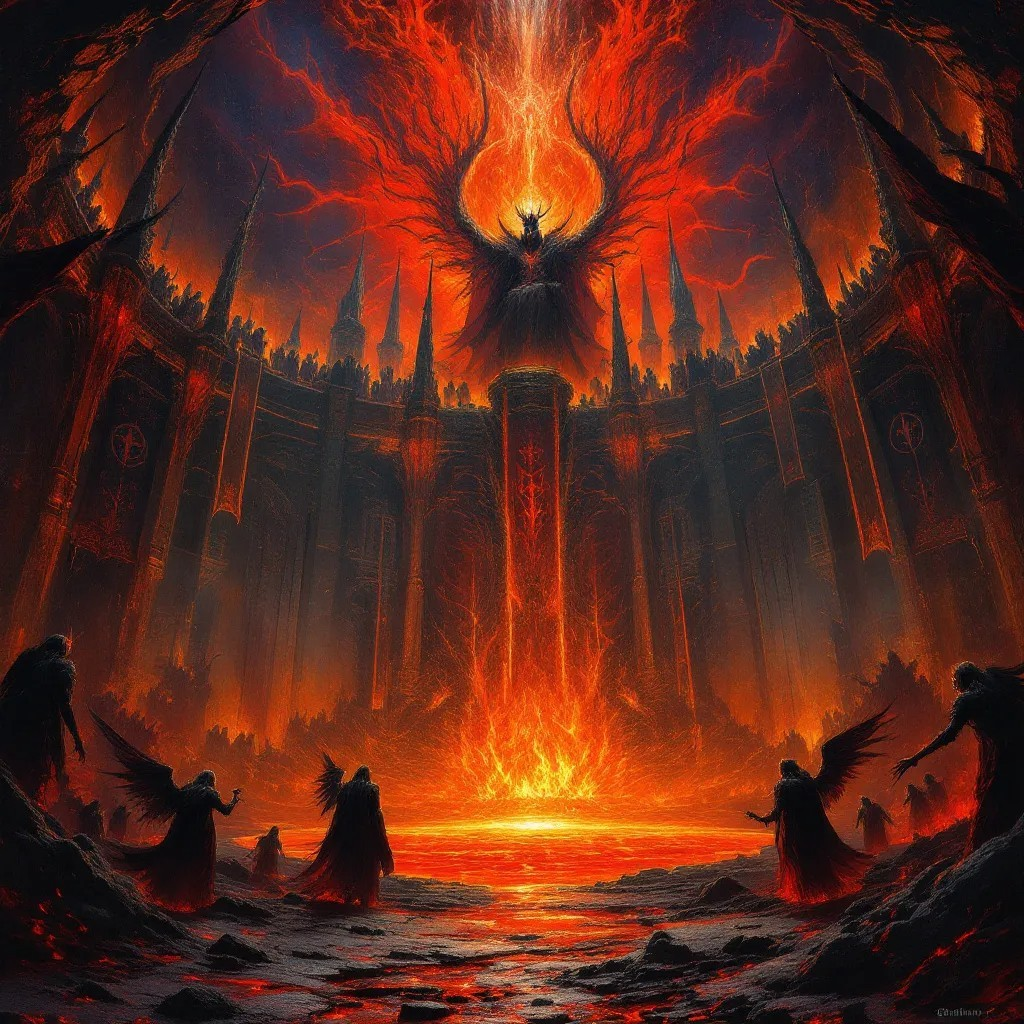
Own the artwork from Chamber IX as a dramatic canvas print. A dark depiction of Pandæmonium — the magnificent infernal capital imagined by John Milton in Paradise Lost.
View Canvas Print Chamber IX · Pandæmonium · Infernal GalleryAmong the most influential literary depictions of Hell after Dante's Inferno is Pandæmonium, the magnificent capital city of Hell described by the English poet John Milton in Paradise Lost, first published in 1667. Pandæmonium is not part of official Christian doctrine. It is Milton's literary vision of Hell as an organized infernal kingdom ruled by Satan and inhabited by countless fallen angels.
The name Pandæmonium was coined by Milton from Greek-derived elements meaning “all demons.” Within the poem, it is the vast palace and governing center where Satan summons the princes of Hell to deliberate over their continuing rebellion against God. The city rises with astonishing magnificence from the infernal landscape, illuminated by the strange and ominous light of Milton's Hell.
Following their defeat in the War in Heaven, Satan and the rebellious angels are cast into Hell. Rather than submit, they attempt to establish a new dominion. Under the direction of the architect-demon Mulciber, the fallen spirits construct Pandæmonium from gleaming infernal materials drawn from beneath the burning plain.
The city becomes the seat of Satan's government and the gathering place for the infernal council, including Beelzebub, Moloch, Belial, and Mammon. The leaders debate whether they should pursue further conflict or turn their attention toward corrupting newly created humanity.
Milton's image of “darkness visible” gives this infernal world one of its most memorable qualities: a dim and corrupted illumination that reveals suffering, pride, ambition, and despair without providing the comfort associated with heavenly light. The grandeur of Pandæmonium therefore stands in deliberate contrast with the spiritual ruin of its inhabitants.
Pandæmonium possesses magnificence without holiness: an infernal capital raised by fallen beings who refuse to abandon their rebellion.
Paradise Lost draws deeply from Scripture, Christian theology, classical epic literature, and the intellectual world of Milton's own time. Yet Pandæmonium itself belongs to Milton's poetic construction of the infernal realm.
Biblical and Christian traditions provided major theological and literary influences for Milton's treatment of Satan, rebellion, judgment, humanity, and the Fall.
Pandæmonium as a magnificent infernal capital, complete with architecture, government, and a council of fallen powers, is a literary creation rather than official Christian doctrine.
In Milton's literary vision, the fallen angels do not remain scattered across the infernal landscape after their defeat. They gather, organize, and establish a center of power within Hell.
Pandæmonium emerges as the monumental expression of that new infernal order. It is not merely a place of suffering. It is a capital—a palace, governmental center, and gathering place for the rebellious spirits who have been cast from Heaven.
Raised within the burning landscape of Hell, Pandæmonium becomes the seat of Satan's government and the great meeting place of the fallen angels. Its magnificence gives visible form to their attempt to create power, order, and dominion within a realm defined by spiritual ruin.
This is one of the defining features of Milton's Hell. The infernal realm is portrayed not simply as a chaotic wilderness, but as a place in which the fallen powers organize themselves into a kingdom of rebellion.
Pandæmonium therefore becomes more than a spectacular building. It symbolizes the continuing refusal of Satan and the fallen angels to submit after their defeat.
Milton surrounds Pandæmonium with imagery of extraordinary infernal magnificence. The palace rises within the burning landscape of Hell, its splendor standing in deliberate tension with the corruption and despair of those who inhabit it.
The result is one of the most enduring visual concepts in Western literary Hell: towering architecture, infernal materials, vast halls, fallen rulers, and an organized kingdom of darkness.
Pandæmonium rises within Milton's infernal landscape, surrounded by the fire and darkness associated with the fallen angels' new realm.
The fallen spirits draw gleaming materials from beneath the burning plain as they raise their magnificent capital within Hell.
At the center stands Pandæmonium itself—the immense palace that serves as the political and governmental center of the fallen angels.
Pandæmonium provides the great assembly place in which the infernal powers gather and deliberate over their continuing rebellion.
The capital gives Milton's Hell an organized political dimension. Satan rules while the princes of Hell gather to debate their future course.
Pandæmonium may appear magnificent, but its outward splendor cannot erase the spiritual corruption, pride, and despair at the heart of Milton's infernal kingdom.
The splendor of the capital does not redeem its inhabitants. Its magnificence becomes part of the tragedy: power and beauty severed from holiness.
Within Milton's account, the construction of Pandæmonium is associated with Mulciber, the architect-demon who directs the creation of the fallen angels' great palace.
Under Mulciber's direction, the fallen spirits transform the resources of the infernal landscape into an immense seat of power. Pandæmonium rises as the architectural center of the new dominion the rebels attempt to establish after their expulsion from Heaven.
The palace therefore serves an important symbolic function. The fallen angels have lost Heaven, yet they continue to imitate the structures of power and grandeur they once knew.
Pandæmonium is impressive precisely because Milton's Hell is not represented only through ugliness. Its magnificence demonstrates how outward glory can exist alongside inward corruption.
Milton's paradoxical image suggests a realm where light allows the fallen spirits to see their condition without offering the hope, comfort, or holiness associated with heavenly illumination.
Within the imagery of Pandæmonium, this strange illumination makes the infernal capital even more unsettling. Its architecture can be seen. Its halls can be entered. Its rulers can gather beneath its grandeur.
Yet the light reveals a kingdom founded upon rebellion, pride, ambition, and despair. Pandæmonium's splendor cannot conceal the spiritual ruin beneath it.
Pandæmonium serves as the seat of Satan's government within Milton's literary Hell. The fallen angels are portrayed as an organized body capable of assembling, deliberating, and considering how their rebellion should continue.
From the infernal capital, Satan summons the princes of Hell to council. Their gathering transforms Pandæmonium from a monument of fallen grandeur into the political center of an organized rebellion against God.
This political dimension helped make Milton's depiction of Hell especially influential. Evil is represented not simply as disorder. It can organize itself, imitate authority, build institutions, and surround itself with the appearance of magnificence.
Yet the organization of Pandæmonium does not transform the fallen kingdom into something holy or redemptive. The order of the city remains inseparable from the rebellion that created it.
Within the great capital, Satan gathers the leaders of the fallen angels. Among the figures named in Milton's infernal assembly are Beelzebub, Moloch, Belial, and Mammon.
Their council concerns the future of the rebellion following their defeat and expulsion from Heaven. The infernal leaders consider whether their struggle should continue through further conflict or through the corruption of newly created humanity.
Named among the leading fallen powers gathered within Pandæmonium for the great infernal council.
One of the prominent infernal figures assembled as the fallen leaders debate the future course of their rebellion.
Included among the demonic princes who gather in the magnificent capital to deliberate over the fallen kingdom's next course.
Another of the major infernal figures present within the organized council of the fallen angels in Pandæmonium.
The gathering in Pandæmonium ultimately directs attention beyond the immediate defeat of the rebels. Newly created humanity becomes central to the continuing conflict, and the infernal council considers corruption as a means of extending its rebellion.
Pandæmonium embodies one of the central tensions in Milton's literary Hell: the contrast between outward magnificence and inward spiritual ruin.
The city is vast. Its architecture is impressive. Its rulers possess organization, ambition, and political purpose. Yet none of these qualities reverse the condition of the fallen spirits.
The infernal capital possesses architecture, wealth, halls of assembly, political order, and the appearance of imperial power.
Beneath that grandeur remains the defining condition of Milton's fallen kingdom: rebellion, pride, corruption, and separation from divine holiness.
Pandæmonium is not frightening because it is merely chaotic. It is frightening because ruin has learned to build a capital.
John Milton's Paradise Lost (England, 17th Century)
Pandæmonium belongs to Milton's literary vision of Hell, shaped by religious, classical, and Renaissance influences.
John Milton wrote Paradise Lost during England's Restoration period following the English Civil War. Deeply influenced by Scripture, classical epic poetry, Renaissance humanism, and Protestant theology, Milton created an expansive literary vision of the fall of Satan, the temptation of humanity, and divine redemption.
Milton's epic emerged from the religious, political, and literary world of seventeenth-century England.
Paradise Lost was first published in 1667, introducing generations of readers to Milton's vast poetic treatment of the Fall, Satan, humanity, Heaven, and Hell.
Milton's invention of Pandæmonium transformed earlier concepts of Hell by portraying it as an organized kingdom complete with government, architecture, and political intrigue.
Though fictional, Milton's vision became one of the defining literary images of Hell in English-speaking culture and has remained influential for more than three centuries.
Milton's influence extends beyond literature and art. The name of his infernal capital eventually entered everyday language.
Today, the word pandemonium is commonly used to describe scenes of overwhelming confusion, disorder, and uproar. Its literary ancestry reaches back to Milton's Pandæmonium—the great gathering place of the infernal host.
The transformation of the name into an everyday word demonstrates the extraordinary cultural reach of Paradise Lost. A fictional capital of Hell became a term used far beyond the poem itself.
Milton's Pandæmonium has had an enduring influence on literature, art, theater, music, fantasy fiction, films, and video games.
The image of Satan presiding over an organized kingdom of darkness became one of the most recognizable portrayals of Hell in Western storytelling. Later fictional visions of demonic empires, infernal capitals, and councils of evil have drawn upon imagery strongly associated with Paradise Lost.
Even the word “pandemonium” has become part of everyday language, used to describe scenes of overwhelming confusion and disorder. Milton's imaginative vision continues to shape cultural perceptions of Hell, demonstrating the extraordinary power of literature to influence popular imagination.
Pandæmonium changed the imaginative geography of Hell. Instead of presenting the infernal realm only as a place where punishment occurs, Milton gave it a monumental center of power.
There are rulers. There is architecture. There is government. There is political deliberation. There is ambition even after catastrophic defeat.
Pandæmonium gives rebellion a capital. Its magnificent architecture cannot overcome the corruption at its foundation, and its political organization cannot reverse the fall of those who inhabit it.
That tension between grandeur and ruin helps explain why Milton's infernal capital has remained so powerful in the cultural imagination.
The council chamber falls silent. Beyond the throne, the towers of Pandæmonium rise against the dim infernal sky while fire glows beneath the distant city.
Chamber IX ends here. The archive continues beyond the gates.
The Next Gate Opens
Leave Milton's Pandæmonium behind and continue deeper into The Encyclopedia of Hell. Another tradition waits beyond the next threshold.
Enter Chamber 10 →AI-Assisted Content Notice: Portions of this entry were drafted with assistance from ChatGPT (OpenAI, 2026) and subsequently edited for accuracy, clarity, and theological consistency.