Fire
Fire is among the principal images associated with Jahannam throughout the Qur’an and represents the severity of punishment and judgment.
The Encyclopedia of Hell · Chamber X
Fire · Scalding Liquid · Qatrān · Seven Gates · Divine Judgment
Tradition: Islam — Qur’anic Descriptions of Jahannam
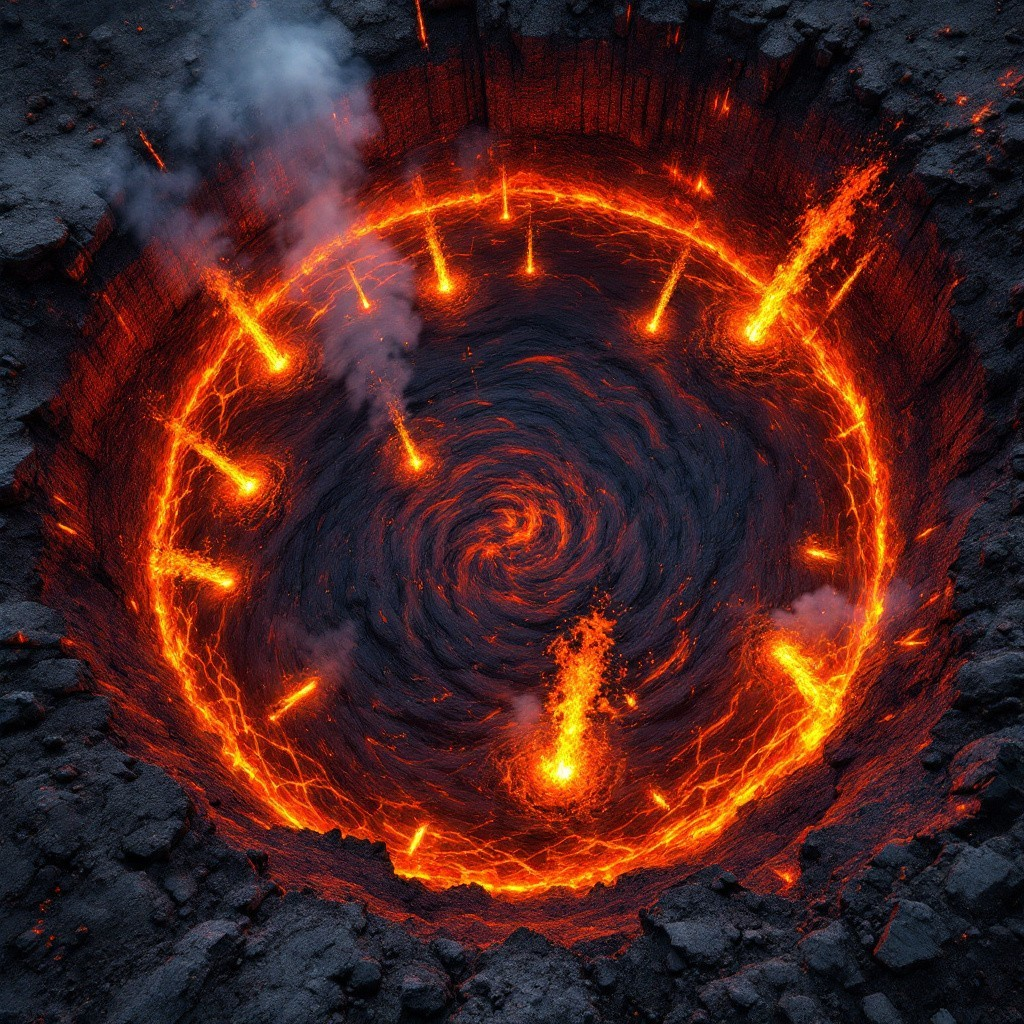
The artwork of Jahannam from Chamber X is available as a dramatic canvas print inspired by the fire, scorching liquid, burning pitch, and seven gates described throughout this chamber.
Chamber X · Jahannam
Buy the Canvas Print Here → Infernal Gallery · Chamber X CollectionAmong the most vivid descriptions of hell in the world's religious traditions is Jahannam, the realm of punishment repeatedly described in the Qur’an. Fire is one of its dominant images, but Qur’anic descriptions also include boiling water, scorching liquid, smoke, and burning substances. Jahannam is presented as a place of divine judgment associated with the consequences of disbelief, rejection of God, and wrongdoing. Rather than depicting hell merely as an uncontrolled blaze, the Qur’an presents an ordered realm of punishment possessing seven gates, with judgment ultimately belonging to God.
Its imagery repeatedly emphasizes overwhelming heat and the terrifying reversal of ordinary sources of comfort: water does not cool the condemned, shade does not provide true relief, and the surrounding fire offers no warmth or security.
Fire is among the principal images associated with Jahannam throughout the Qur’an and represents the severity of punishment and judgment.
Qur’anic descriptions repeatedly reverse the ordinary comfort of water, presenting heated and scalding liquid as part of the punishment of Jahannam.
Qur’an 14:49–50 describes the guilty in garments of qatrān, commonly translated as pitch or tar, while fire covers their faces.
Qur’an 15:43–44 describes Jahannam as possessing seven gates, presenting hell as an ordered realm associated with divine judgment.
One of the most disturbing recurring images is that of boiling water. The inhabitants of Jahannam are described as encountering intensely heated liquid rather than the refreshment normally associated with water. Other passages describe boiling water being poured over the condemned.
Qur’an 18:29 describes a drink compared to molten metal that scalds the faces of those who call for relief. Qur’an 47:15 contrasts the rewards of Paradise with boiling water given to drink. Within these descriptions, something normally associated with life and relief becomes part of the imagery of punishment.
Qur’an 18:29 · Qur’an 22:19–22 · Qur’an 38:55–58 · Qur’an 47:15
Another striking image appears in Qur’an 14:49–50, where the guilty are described as bound together in chains and wearing garments of qatrān, a term commonly translated as pitch or tar, while fire covers their faces.
The image joins dark combustible material with the surrounding fire of judgment. Together with the Qur’an’s descriptions of boiling and scorching liquids, it contributes to one of the most severe visual portrayals of Jahannam.
The Qur’an does not simply describe one literal “pit filled with boiling pitch.” Its imagery comes from several passages: boiling and scorching liquids appear in some descriptions, while qatrān appears separately as the material of garments in Qur’an 14:50. This chamber brings those related images together while preserving that distinction.
Jahannam is not presented merely as uncontrolled fire. Qur’an 15:43–44 describes Hell as possessing seven gates, with an assigned portion associated with each gate. The passage contributes to the image of an ordered realm of judgment rather than a shapeless inferno.
This visual arrangement is symbolic. The Qur’anic passage states that Jahannam has seven gates; the numbered gateway design above is an artistic interface element and is not intended to assign names, architecture, or additional characteristics not supplied by the passage.
Fire is one of the principal images associated with Jahannam throughout the Qur’an. Its presence emphasizes the severity of divine judgment and the consequences associated with disbelief and wrongdoing. The Qur’anic descriptions do not present the fire simply as background scenery. It is part of the punishment itself, surrounding the condemned and forming one of the most recognizable images of Jahannam.
Other descriptions intensify this imagery through overwhelming heat, smoke, scalding liquid, and the terrifying sound of the infernal realm. Qur’an 67:6–8 describes the roaring sound of Jahannam as those condemned to it are cast within. Together, these images present a realm in which the ordinary comforts of the physical world have been reversed: heat gives no comfort, liquid gives no refreshment, and the surrounding environment becomes part of the experience of judgment.
The Qur’an repeatedly returns to images of blazing fire and unbearable heat when warning of Jahannam. These descriptions function within its larger teachings concerning the Day of Judgment, moral accountability, repentance, mercy, punishment, and reward.
Qur’an 67:6–8 — Jahannam is described through the terrifying imagery of a roaring fire.
The punishments associated with Jahannam cannot be separated from the Qur’an’s larger teachings concerning divine judgment. Jahannam is presented in connection with human accountability before God and the consequences of disbelief, rejection of God, and wrongdoing. Its frightening imagery therefore serves a religious purpose beyond the description of an infernal landscape.
The Qur’an repeatedly places warnings of punishment within a broader message concerning righteousness, repentance, mercy, Paradise, and the final judgment. Jahannam consequently forms one part of a larger Qur’anic vision of the afterlife in which human actions possess moral significance and judgment ultimately belongs to God.
Fire, boiling water, scorching liquid, chains, and burning pitch form some of the most severe images associated with Jahannam, but the underlying theme is judgment. Within the Qur’anic framework, these warnings reinforce the seriousness of moral choice, responsibility before God, and the distinction between punishment and reward.
The imagery of Jahannam is severe, but it exists within a religious message that also emphasizes repentance, mercy, righteousness, and the possibility of forgiveness. The Qur’an’s warnings concerning punishment call attention to the seriousness of human choices and the expectation that individuals will ultimately answer for their actions.
Jahannam is associated with final judgment and the consequences of human moral and spiritual choices.
Qur’anic descriptions of punishment reinforce the idea that actions and beliefs possess consequences before God.
Warnings concerning punishment exist within broader Qur’anic teachings that repeatedly call people toward repentance and righteousness.
Islamic teachings concerning Jahannam exist alongside equally important teachings concerning God's mercy and forgiveness.
One of the important features of the Qur’anic depiction of Jahannam is that it is not described merely as an uncontrolled mass of flame. The reference to seven gates in Qur’an 15:43–44 contributes to an image of structure and order. Each gate is associated in the passage with an assigned portion of those who enter.
This distinguishes the Qur’anic image from a purely chaotic vision of fire. Jahannam remains terrifying, but its terror exists within the framework of judgment rather than random destruction. The flames, gates, scalding liquids, and other punishments belong to an afterlife in which judgment ultimately rests with God.
The seven gates provide one of the Qur’an’s most striking structural images of Jahannam. This chamber does not assign names or invented functions to those gates; it preserves the description given in Qur’an 15:43–44.
Unlike later literary constructions of hell, such as Dante’s Inferno or Milton’s Pandæmonium, the foundational descriptions examined in this chamber come directly from Islam’s sacred scripture, the Qur’an.
These passages provide the principal textual foundation for the images of fire, scorching liquid, qatrān, seven gates, and divine judgment discussed in this chamber.
The concept of Jahannam developed within the Qur’anic revelations of the 7th century CE, where warnings concerning the Day of Judgment, resurrection, Paradise, and punishment form an important part of the Qur’an’s religious message. The Arabic term Jahannam is historically related to the name Gehenna, itself associated with the Valley of Hinnom near Jerusalem, but within the Qur’an Jahannam becomes part of a distinctly Islamic vision of final judgment.
Qur’anic passages describe fire, boiling water, scorching liquids, chains, and other punishments while emphasizing that God judges humanity with perfect knowledge and justice. Over subsequent centuries, Muslim theologians, Qur’anic commentators, scholars, poets, and religious writers examined these passages in greater detail. Interpretations differed concerning particular features of the afterlife, but the Qur’an remained the foundational authority for Islamic descriptions of Jahannam.
Qur’anic revelations establish the foundational Islamic descriptions of Jahannam, resurrection, judgment, punishment, Paradise, and the afterlife.
Fire, boiling water, scorching liquid, qatrān, chains, and seven gates become part of the scriptural imagery associated with punishment and final judgment.
Muslim theologians and Qur’anic commentators examine the scriptural descriptions and discuss their meanings within broader Islamic teachings concerning judgment and the afterlife.
Scholars, poets, preachers, and religious writers continue to engage with the Qur’anic imagery of Jahannam while the Qur’an remains the foundational authority for the tradition.
The Arabic term Jahannam is historically related to the name Gehenna, a term itself connected with the Valley of Hinnom near Jerusalem. This linguistic relationship places Jahannam within a much older history of religious language concerning punishment and the afterlife.
Within the Qur’an, however, Jahannam belongs to the distinctly Islamic presentation of resurrection, divine judgment, Paradise, and punishment. The connection provides an important historical bridge between this chamber and the Encyclopedia’s separate examination of Gehenna.
Descriptions of Jahannam have played an important role in Islamic preaching, theology, devotional literature, Qur’anic commentary, poetry, and religious storytelling. Images of blazing fire, boiling water, seven gates, chains, and divine judgment became powerful reminders of moral responsibility and the consequences of human actions.
At the same time, Islamic teachings concerning hell exist alongside equally important teachings concerning God's mercy, forgiveness, repentance, and Paradise. For this reason, Jahannam is best understood within the Qur’an’s larger vision of the afterlife rather than simply as a collection of frightening punishments.
Its imagery serves as a warning about judgment while reinforcing the seriousness of moral choice, accountability before God, and the ultimate distinction between punishment and reward.
Muslim commentators have examined passages concerning Jahannam as part of the wider interpretation of the Qur’an and its teachings about judgment and the afterlife.
Discussions of punishment, judgment, accountability, mercy, and the afterlife became important subjects within Islamic theological thought.
Qur’anic warnings concerning Jahannam have been used to emphasize moral responsibility, repentance, righteousness, and accountability before God.
Reflection on judgment, Paradise, punishment, mercy, and the fate of the soul became part of a broader devotional engagement with the afterlife.
Later religious writers and poets engaged with themes of judgment and the afterlife while drawing upon the foundational imagery preserved in Islamic scripture.
The imagery of Jahannam continues to function as a powerful religious warning concerning human choices and their consequences.
Several recurring images give the Qur’anic descriptions of Jahannam their extraordinary intensity. They should not be collapsed into a single description of one physical location. Instead, they appear across different passages and together form the scriptural imagery examined in this chamber.
Blazing fire is one of the dominant images associated with Jahannam and the severity of divine judgment.
Water, normally associated with life and relief, appears in descriptions of scalding punishment rather than refreshment.
Qur’an 14:49–50 describes garments of qatrān, commonly translated as pitch or tar, together with the image of fire covering the faces.
Qur’an 15:43–44 describes Jahannam as possessing seven gates, contributing to the image of an ordered realm of judgment.
The terror of Jahannam does not arise simply from fire or physical suffering. Within the Qur’anic framework, these images belong to a larger teaching concerning final judgment, moral responsibility, punishment, repentance, mercy, and reward.
The visual design of this chamber is intentionally dark and dramatic, but the artwork and interface should not be confused with the Qur’anic text itself. The flames, gates, abyssal architecture, smoke, and other visual elements used throughout this page are modern artistic devices inspired by the subjects discussed in the chapter.
The foundational material remains the Qur’anic descriptions themselves. Later Islamic theology, commentary, preaching, poetry, and religious literature expanded discussion of Jahannam, but this chamber distinguishes those broader traditions from the specific Qur’anic passages listed in the Primary Sources section.
The Encyclopedia of Hell examines beliefs, scriptures, literature, mythology, and cultural representations of the afterlife. Visual elements on this page are interpretive and are not presented as authoritative depictions of Islamic belief.
The flames, boiling water, scorching liquid, qatrān, chains, and seven gates make Jahannam one of the most visually powerful portrayals of punishment examined within this encyclopedia. Yet these images exist within the Qur’an’s larger teachings concerning divine judgment, moral accountability, repentance, mercy, Paradise, punishment, and reward.
The gates have been counted, but the descent is not finished. Continue into Chamber 11 and explore traditions concerning the divisions and layers associated with the Islamic understanding of Hell.
Descend Into Chamber 11 →