Jahannam — Hell
The most familiar Qur’anic name for Hell and the central term around which later Islamic descriptions of infernal punishment developed. The Qur’an describes Jahannam as possessing seven gates, each with an assigned portion.
Chamber 11 · Beyond the Seven Gates
Jahannam. Laẓā. Al-Ḥuṭamah. Al-Saʿīr. Saqar. Al-Jaḥīm. Al-Hāwiyah.
Tradition: Islam — Sunni & Shiʿa Traditions Concerning the Seven Divisions of Hell
Bring the imagery of Chamber 11 beyond the archive with a canvas print inspired by the Seven Divisions of Hell — Jahannam, Laẓā, Al-Ḥuṭamah, Al-Saʿīr, Saqar, Al-Jaḥīm, and Al-Hāwiyah.
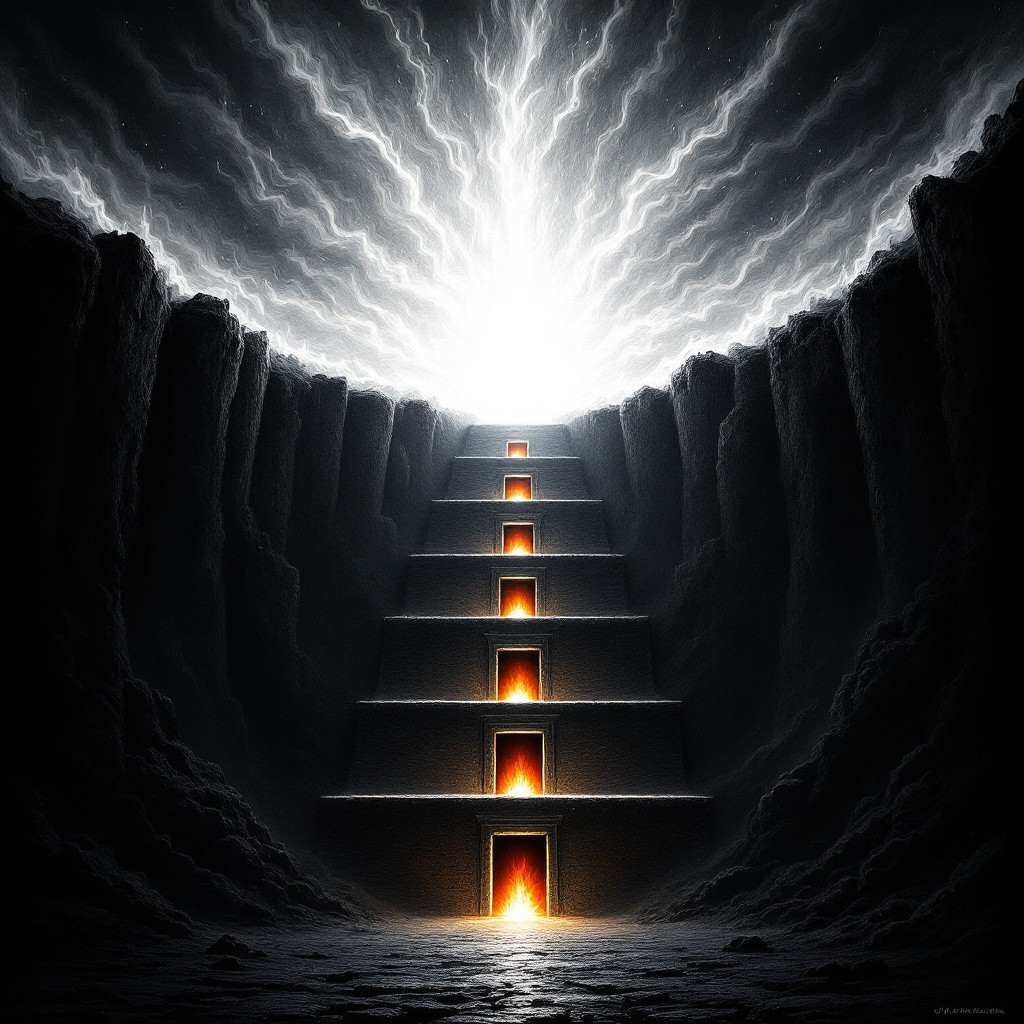
The Seven Divisions of Hell · Chamber XI
View Canvas Print Chamber XI · Infernal Artwork CollectionWithin Islamic teachings about the afterlife, Jahannam is the most familiar name for Hell, but the Qur’an employs several additional terms associated with the realm or fire of punishment. These include Laẓā, al-Ḥuṭamah, al-Saʿīr, Saqar, al-Jaḥīm, and al-Hāwiyah. Later Muslim commentators and religious traditions sometimes organized these Qur’anic names into a scheme of seven divisions, levels, or gates of Hell, although the precise arrangement and interpretation vary among sources.
The Qur’anic foundation for the number seven appears most clearly in Qur’an 15:43–44, where Jahannam is described as having seven gates, with an assigned portion destined for each gate. The Qur’an does not, however, provide a single passage presenting seven named levels in a numbered descending order. The familiar conception of seven divisions therefore represents a later theological and exegetical organization of several Qur’anic terms and images associated with Hell.
The seven gates are explicitly Qur’anic. The familiar arrangement of Jahannam, Laẓā, al-Ḥuṭamah, al-Saʿīr, Saqar, al-Jaḥīm, and al-Hāwiyah as seven distinct descending divisions belongs to later theological and exegetical traditions. The precise order and interpretation can vary among sources.
Each name contributes distinctive imagery to the Islamic conception of punishment. Laẓā conveys the image of fiercely blazing fire. Al-Ḥuṭamah, often rendered “the Crusher,” suggests a devastating and consuming punishment. Al-Saʿīr signifies a blazing or kindled fire, while Saqar appears as an overwhelming infernal fire. Al-Jaḥīm likewise evokes a blazing inferno, and al-Hāwiyah suggests an abyss or plunging depth. Together with Jahannam, these terms provided later commentators with a vocabulary through which Hell could be imagined as an ordered realm possessing multiple divisions.
Both Sunni and Shiʿa traditions affirm Hell, resurrection, divine judgment, and human accountability, although individual theologians and commentators have differed concerning the exact organization and inhabitants of Hell’s divisions. The sevenfold conception should therefore be understood as an important later interpretive tradition rooted in Qur’anic terminology and the Qur’an’s seven gates , rather than as a precise seven-level map explicitly presented in scripture.
At the foundation of later traditions concerning seven divisions stands the Qur’anic description of Jahannam as possessing seven gates. The passage describes an assigned portion for each gate, presenting Hell not merely through the imagery of flame, but also through an image of order, division, and judgment.
Later commentators and traditions sometimes connected the Qur’an’s seven gates with seven named divisions of Hell. This produced one of the most recognizable structured images of Jahannam in later Islamic eschatological tradition.
Qur’an 15:43–44 provides the central scriptural basis for the number seven by describing Jahannam as possessing seven gates, with an assigned portion for each gate.
Later Islamic interpretive traditions sometimes gathered several Qur’anic names associated with Hell and infernal punishment into a sevenfold structure. In these classifications, the names become a way of imagining a descending infernal order: a succession of terrifying regions associated with fire, crushing punishment, blazing heat, and the abyss.
The arrangement below presents the seven names discussed in this chamber as a symbolic descent. It should not be read as a claim that the Qur’an itself provides this exact numbered map.
The most familiar Qur’anic name for Hell and the central term around which later Islamic descriptions of infernal punishment developed. The Qur’an describes Jahannam as possessing seven gates, each with an assigned portion.
Laẓā evokes the terror of a fiercely blazing fire. In the Qur’anic imagery discussed in this chamber, the name contributes to the conception of Hell as an overwhelming realm of burning punishment.
Often rendered “the Crusher,” al-Ḥuṭamah carries imagery of devastating, consuming punishment and is associated with the kindled fire of God in the Qur’anic passages discussed in this chamber.
Al-Saʿīr signifies a blazing or kindled fire and appears in Qur’anic language concerning punishment. Within later sevenfold classifications, the term becomes another name associated with an infernal division.
Saqar is presented through terrifying Qur’anic imagery as a fire that neither spares nor leaves. Qur’an 74:26–30 also associates Saqar with nineteen appointed over it.
Al-Jaḥīm evokes the image of a blazing inferno. The Qur’anic material associated with this name includes descriptions of punishment involving the tree of Zaqqūm and scalding drink.
Al-Hāwiyah suggests an abyss, plunging depth, or terrible fall. Qur’an 101:8–11 associates al-Hāwiyah with an abyss whose nature is described as raging fire.
The visual descent into seven regions is an interpretive presentation of later tradition—not a literal map supplied by the Qur’an. The image of the abyss nevertheless gives the sevenfold conception its most haunting visual conclusion: a final plunge into darkness and raging fire.
The sevenfold conception draws together several terms that appear separately within the Qur’an. Later commentators and religious traditions sometimes associated these names with distinct divisions, levels, regions, or gates of Hell. Their exact arrangement is not uniform across later sources, but together they formed a powerful vocabulary for describing the infernal realm.
The most familiar Islamic name for Hell. Jahannam appears repeatedly in the Qur’an and forms the central term around which many later descriptions of the Islamic infernal realm developed.
Qur’an 70:15–16 describes Laẓā as a fiercely blazing fire. Its name contributes the image of overwhelming flame to later classifications of Hell.
Often rendered “the Crusher,” al-Ḥuṭamah appears in Qur’an 104:4–9 and is associated with the kindled fire of God. The name conveys imagery of devastating and consuming punishment.
Al-Saʿīr signifies a blazing or kindled fire. Qur’an 4:10 uses the term in connection with divine punishment and entry into a blazing fire.
Qur’an 74:26–30 presents Saqar as a terrible fire that neither spares nor leaves. The passage also states that nineteen are appointed over it.
Al-Jaḥīm evokes a blazing inferno. Qur’an 37:55–68 contains an extended description of punishment associated with al-Jaḥīm, including the tree of Zaqqūm and scalding drink.
Al-Hāwiyah suggests an abyss or plunging depth. Qur’an 101:8–11 associates it with an abyss whose nature is described as raging fire.
These seven names do not appear together in the Qur’an as a numbered list of seven descending levels. The Qur’an explicitly describes seven gates and separately uses these names and terms in passages concerning Hell and infernal punishment. Their systematic arrangement into seven divisions belongs to later Islamic theological and exegetical interpretation.
The sevenfold tradition draws upon several Qur’anic passages. These passages provide the scriptural terminology and imagery later commentators used when discussing the gates, names, and divisions of Hell.
Among these passages, Qur’an 15:43–44 is especially important to the later sevenfold conception because it explicitly states that Jahannam possesses seven gates.
The distinction between seven gates and seven named levels is important when examining the historical development of this belief. The Qur’an provides the explicit statement that Jahannam possesses seven gates. It also contains the individual names Jahannam, Laẓā, al-Ḥuṭamah, al-Saʿīr, Saqar, al-Jaḥīm, and al-Hāwiyah in different passages.
What the Qur’an does not provide is a single passage declaring that those seven names form a numbered sequence of seven descending regions. That more elaborate structure emerged through later interpretation, as Muslim scholars and commentators examined the different Qur’anic terms and attempted to understand their relationship to the seven gates.
The number seven is explicit in the Qur’an’s description of the gates of Jahannam. The organization of individual Qur’anic names into seven corresponding divisions is a later interpretive development.
Separating the Qur’anic text from later classifications allows the sevenfold tradition to be presented without treating one particular later arrangement as though it were a precise map explicitly supplied by scripture. Different later sources could organize, interpret, or describe the divisions differently.
One of the most striking features of the sevenfold conception is its sense of structure. Hell is not imagined merely as an endless, uncontrolled wilderness of fire. The Qur’anic image of seven gates and later traditions concerning multiple divisions instead contributed to the conception of an infernal realm existing beneath divine authority.
In later classifications, the idea of descending divisions could provide a way of visualizing differences in punishment and moral accountability. Yet the precise details were not uniform. Different commentators and traditions could interpret the names, divisions, ordering, and inhabitants differently.
Gates. Fire. Crushing punishment. Blazing heat. Scalding drink. The abyss. Later interpretation brought these separate Qur’anic images together into one of the most recognizable structured visions of Hell in Islamic eschatological tradition.
Both Sunni and Shiʿa traditions contain teachings concerning Hell, resurrection, divine judgment, and human accountability. The Qur’anic descriptions of Jahannam and the final judgment therefore belong to a shared scriptural foundation.
Individual theologians and commentators, however, have differed concerning particular details of the afterlife, including the exact organization and inhabitants of Hell’s divisions. The sevenfold scheme should consequently not be treated as though every Muslim scholar or every later source supplied an identical infernal map.
Whatever differences developed concerning the organization of the divisions, the larger religious framework remained centered upon resurrection, judgment, divine justice, human accountability, repentance, mercy, punishment, and reward .
The sevenfold conception did not emerge from a single Qur’anic passage laying out an infernal diagram. Instead, its foundation was assembled from two important elements already present in the Qur’an: the explicit statement that Jahannam possesses seven gates, and the separate Qur’anic names and descriptions associated with infernal punishment.
During later centuries, Muslim commentators and religious traditions examined these passages together. Within some interpretive traditions, the seven gates became associated with seven divisions or levels, while the different Qur’anic names for Hell were organized into structured classifications.
That development transformed separate scriptural terms into the image explored throughout this chamber: a vast infernal realm of seven gates, seven names, and descending divisions .
The next stage of this chamber follows the sevenfold tradition through its historical development and examines how the image entered Islamic theology, commentary, devotional literature, poetry, storytelling, and later artistic representations.
The foundation of the sevenfold conception of Hell begins with the Qur’an in the 7th century CE. Rather than presenting a detailed diagram of seven descending levels, the Qur’an states that Jahannam possesses seven gates and separately uses a number of powerful names and descriptions for infernal punishment. Among these are Jahannam, Laẓā, al-Ḥuṭamah, al-Saʿīr, Saqar, al-Jaḥīm, and al-Hāwiyah.
During the centuries following the Qur’anic revelations, Muslim scholars and Qur’anic commentators examined these passages and attempted to explain their relationship to one another. Within some later interpretive traditions, the seven gates became associated with seven divisions or levels, and the various Qur’anic names for Hell were organized into structured classifications. Different sources did not always agree on their precise order, characteristics, or intended inhabitants.
For this reason, a distinction should be maintained between the Qur’anic foundation and its later theological development. The seven gates are explicitly Qur’anic, as are the individual names associated with infernal punishment. The systematic arrangement of those names into seven distinct layers belongs largely to later Islamic interpretation and commentary.
Over time, this sevenfold structure became one of the recognizable ways in which Islamic Hell was described in theological, devotional, literary, and popular traditions. It transformed several separate Qur’anic terms into an image of a vast and ordered infernal realm while preserving the central Islamic teaching that final judgment ultimately belongs to God.
The Qur’anic revelations provide the foundation. Jahannam is described as possessing seven gates, while other passages employ names including Laẓā, al-Ḥuṭamah, al-Saʿīr, Saqar, al-Jaḥīm, and al-Hāwiyah.
The individual names and infernal images exist within scripture, but the Qur’an does not present them together as one numbered map of seven descending levels.
Muslim scholars and Qur’anic commentators examined the seven gates alongside the different Qur’anic names for Hell. Some interpretive traditions began associating the names with distinct divisions or levels.
Later sources organized the infernal names into increasingly structured classifications. Their precise order, characteristics, and assigned inhabitants could vary from one source or tradition to another.
The sevenfold conception became part of theological discussion, devotional literature, preaching, poetry, storytelling, and other expressions of Islamic religious imagination.
Seven gates and multiple names for infernal punishment became the foundation for one of the most recognizable later structured visions of Hell within Islamic tradition.
The conception of Hell as possessing seven gates or divisions contributed to the rich development of Islamic eschatological literature and religious imagination. Qur’anic commentators, theologians, preachers, poets, and later religious writers expanded upon scriptural descriptions of Jahannam while attempting to understand the significance of its seven gates and the different names used for infernal punishment.
Names such as Laẓā, Saqar, al-Jaḥīm, and al-Hāwiyah became powerful symbols of divine judgment. The idea of descending divisions also provided a compelling way of visualizing differences in punishment and moral accountability, even though Islamic sources vary concerning exactly how such divisions should be understood.
Commentators examined the Qur’an’s seven gates and its different names for infernal punishment, contributing to later attempts to understand their relationship.
The divisions were discussed within broader teachings concerning resurrection, divine judgment, justice, punishment, accountability, and the afterlife.
Images of Hell’s gates, blazing fires, and descending regions provided powerful ways of communicating warnings concerning judgment and moral responsibility.
The imagery of Jahannam and its divisions entered later devotional discussions of the afterlife, accountability, repentance, and divine mercy.
The language of blazing fire, infernal depths, gates, and judgment supplied later writers and storytellers with a powerful vocabulary for imagining the afterlife.
Later artistic interpretations could transform the idea of seven divisions into a visual descent through fire, darkness, gates, and increasingly terrifying infernal depths.
The sevenfold conception has consequently appeared in religious teaching, Qur’anic commentary, devotional literature, poetry, storytelling, and later artistic representations of the Islamic afterlife. It presents Hell as structured rather than chaotic: its gates, punishments, and inhabitants remain subject to divine authority.
Islamic teachings concerning the seven divisions of Hell cannot be separated from the wider religious framework in which they appear. Warnings concerning punishment stand alongside teachings about repentance, forgiveness, divine mercy, righteous conduct, resurrection, and Paradise.
The seven divisions therefore function not simply as frightening images of an infernal world, but as part of a larger theological vision emphasizing human accountability before God and the consequences associated with the final judgment.
Jahannam exists within teachings concerning resurrection and final judgment rather than as an independent realm beyond divine authority.
The imagery of gates and divisions reinforces the seriousness of moral responsibility and the consequences associated with human actions.
Warnings concerning punishment exist alongside teachings concerning repentance and the possibility of turning toward righteous conduct.
Islamic teachings concerning Hell belong to a wider framework that also contains teachings concerning God’s mercy and forgiveness.
The infernal realm forms part of the larger Islamic teaching concerning resurrection and the final destiny of humanity.
Descriptions of punishment exist alongside teachings concerning Paradise and the ultimate distinction between punishment and reward.
The seven divisions are best understood within the larger Islamic vision of the afterlife. Their purpose is not merely to provide a terrifying geography of Hell, but to reinforce teachings concerning judgment, accountability, repentance, mercy, punishment, and reward.
Taken together, the Qur’anic terminology and later classifications produce an imposing image of Hell: a realm entered through gates, defined by divine judgment, and described through the language of blazing fire, crushing punishment, consuming heat, and terrifying depth.
Qur’an 15:43–44 provides the explicit sevenfold foundation by describing Jahannam as possessing seven gates.
Laẓā, al-Saʿīr, Saqar, and al-Jaḥīm contribute powerful imagery of burning and infernal fire.
Al-Ḥuṭamah contributes the image of devastating and consuming punishment.
Al-Hāwiyah contributes the terrifying image of a plunging depth associated with raging fire.
Later tradition could transform separate Qur’anic names into the image of a descending infernal architecture. Yet beneath every gate and every later classification remains the same central theme: the realm is subject to divine judgment rather than existing as an independent kingdom of chaos.
You have descended through the sevenfold vision of Jahannam. Beyond this threshold waits another interpretation of infernal fire—one in which burning becomes more than physical flame. Chamber 12 awaits.
Descend to Chamber 12 →