I
Karma
Harmful actions and destructive passions bind karma to the soul and influence future existence.
The Encyclopedia of Hell · Jainism
Beneath the worlds of ordinary existence lie infernal regions of terrible suffering—but no sentence here lasts forever. In Jain cosmology, Naraka belongs to the cycle of karma, death, suffering, and rebirth.
The suffering may endure beyond imagination. Yet even the deepest infernal existence remains inside the wheel of rebirth.
Within Jainism, Naraka refers to the infernal realms into which a living being may be reborn as a consequence of destructive karma accumulated through harmful actions, passions, and attachments. Unlike doctrines in which hell represents an eternal sentence imposed by a divine judge, Jain Naraka exists within samsara, the vast cycle of birth, death, and rebirth.
A being born into one of these hellish realms may experience extraordinary suffering for an immensely long period, but the condition is ultimately temporary. When the lifespan associated with that particular infernal rebirth has ended, the being dies and is eventually reborn elsewhere within samsara according to its remaining karma.
Naraka is terrible precisely because its suffering can be unimaginably prolonged—yet it remains part of rebirth rather than an eternal destination.
Jain cosmology traditionally places the hellish realms within the lower portion of the universe and describes seven principal infernal regions, with conditions generally becoming increasingly severe at greater depths.
The beings inhabiting these regions, often called narakis, experience intense suffering arising from their karmic condition. Jain descriptions include darkness, extreme temperatures, terrifying environments, bodily torment, conflict, and other forms of misery.
Jain cosmology traditionally describes seven principal infernal regions within the lower universe. The deeper descent represents increasingly severe conditions of infernal existence.
These punishments are not administered by an all-powerful creator deity. Jainism instead understands karma as a natural moral mechanism through which actions and passions affect the soul and determine future forms of existence.
This conception of Naraka is closely connected to the Jain principle of ahimsa, or nonviolence. Actions motivated by cruelty, violence, hatred, greed, deceit, attachment, and other destructive passions bind harmful karma to the soul.
Particularly severe karmic accumulation can contribute to rebirth within the infernal realms. Naraka therefore illustrates the consequences of harming other living beings and reinforces Jainism's rigorous emphasis on ethical discipline and self-control.
Even the suffering of Naraka does not last forever. Hell-beings eventually leave their infernal existence through another rebirth. Escape from Naraka, however, is not the same as liberation.
As long as karma remains attached to the soul, rebirth continues. The ultimate Jain goal is moksha—complete liberation from karma and samsara, ending the cycle that makes heavenly, earthly, animal, and infernal rebirth possible.
Harmful actions and destructive passions bind karma to the soul and influence future existence.
Severe karmic conditions may result in rebirth within Naraka and an immensely prolonged period of suffering.
When the infernal lifespan ends, existence continues within samsara until karmic bondage itself is overcome.
Jain teachings concerning Naraka belong to the religion's larger doctrines of karma, conduct, cosmology, rebirth, and liberation.
An important source for Jain teachings concerning the structure of the cosmos, infernal beings, karma, and rebirth.
Contains teachings concerning karma, ethical conduct, rebirth, spiritual discipline, and liberation.
An early Jain source associated with teachings concerning conduct and the consequences of harmful actions.
Jain cosmological traditions describe seven principal infernal regions situated within the lower portion of the universe.
Jain teachings concerning karmic bondage and the cycle of rebirth provide the doctrinal framework through which Naraka is understood.
Nonviolence and liberation are essential to understanding why harmful conduct leads toward bondage while spiritual discipline leads toward freedom from samsara.
Infernal existence may last an extraordinary length of time, but it is not eternal.
Hell is one possible form of rebirth within the continuing cycle of birth, death, and rebirth.
Jain cosmology traditionally describes seven principal infernal regions within the lower universe.
Beings born within Naraka experience extremely severe and prolonged forms of suffering.
An infernal lifespan may be unimaginably long while nevertheless remaining finite.
Infernal rebirth is not presented as a sentence handed down by an all-powerful creator God.
Naraka is understood through the operation of karma and the consequences of actions and passions.
Violence, cruelty, hatred, greed, deceit, and destructive attachment contribute to harmful karmic bondage.
Nonviolence toward living beings occupies a central place within Jain ethical practice.
When an infernal lifespan ends, the being dies and eventually undergoes another rebirth.
Escape from an infernal existence does not itself free the soul from the larger cycle of samsara.
Complete liberation occurs only through freedom from karma and samsara.
Jain teachings concerning Naraka developed within the religion's broader doctrines of karma, samsara, and the structure of the universe. Jainism presents the cosmos as eternal and operating according to natural principles rather than as a creation governed by a creator God.
Within this cosmology, living beings move through different forms of existence according to the karma bound to their souls.
Jain scriptures and later cosmological traditions developed detailed descriptions of the lower regions of the universe and the beings inhabiting them. Seven principal infernal regions became part of the traditional Jain map of the cosmos, with increasingly severe conditions associated with the deeper realms.
The deeper terror of Naraka is not an eternal verdict. It is the consequence of bondage within a universe in which actions continue beyond a single lifetime.
These teachings reinforced the Jain conviction that harmful conduct produces consequences extending far beyond a person's present lifetime.
Despite the enormous periods of suffering attributed to infernal existence, Jainism does not generally present Naraka as everlasting damnation. A hell-being remains within its particular existence for its predetermined lifespan and then continues through samsara.
The doctrine therefore places Naraka within a much larger spiritual problem: every form of rebirth remains a form of bondage. The ultimate objective is not simply avoiding hell, but eliminating karma and escaping the cycle of rebirth entirely.
Descriptions of Naraka have reinforced some of Jainism's most distinctive ethical teachings, particularly ahimsa, self-restraint, truthfulness, nonattachment, and responsibility for one's actions.
The possibility of infernal rebirth dramatically illustrates the consequences attributed to violence and destructive passions.
Jain cosmological diagrams, manuscripts, religious instruction, and artistic representations have depicted the lower worlds as part of the larger structure of samsara.
These images place Naraka within an ordered universe governed by karmic causation rather than divine punishment.
Avoiding Naraka is not the final victory. As long as karmic bondage remains, the wheel continues.
The doctrine consequently functions both as a warning against harmful conduct and as an illustration of the deeper Jain understanding of existence.
Even escaping an infernal realm does not solve the problem of suffering permanently. Heavenly existence, human life, animal existence, and Naraka all remain within samsara.
Only the removal of karmic bondage and attainment of moksha provide final liberation.
Inspired by Chamber XVI and the seven descending infernal regions of Jain Naraka, this canvas print transforms the atmosphere of the chamber into a collectible work of dark art.
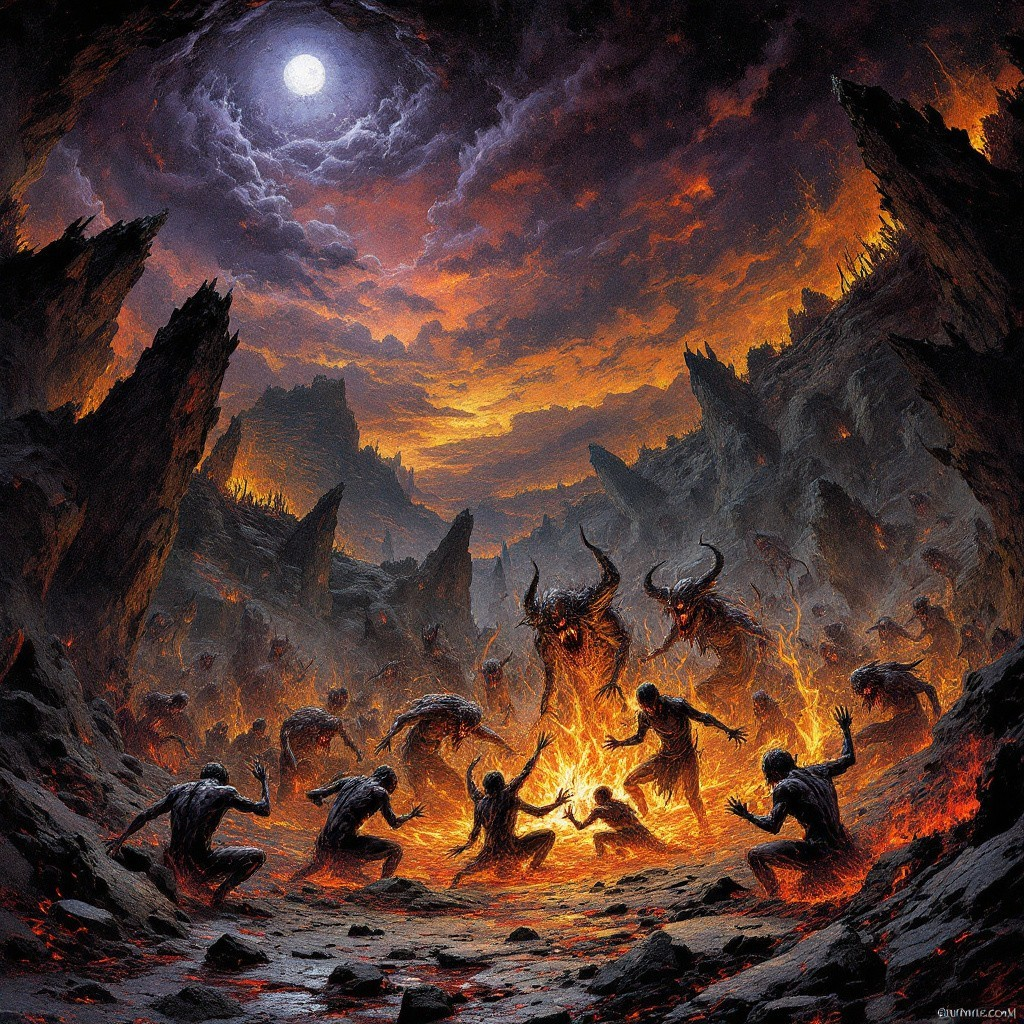
A visual interpretation inspired by the descent, karmic consequence, and immense yet finite suffering explored within Chamber XVI.
View the Canvas Print →Artwork is an atmospheric interpretation inspired by the chamber and is not intended as a literal depiction of Jain sacred imagery.